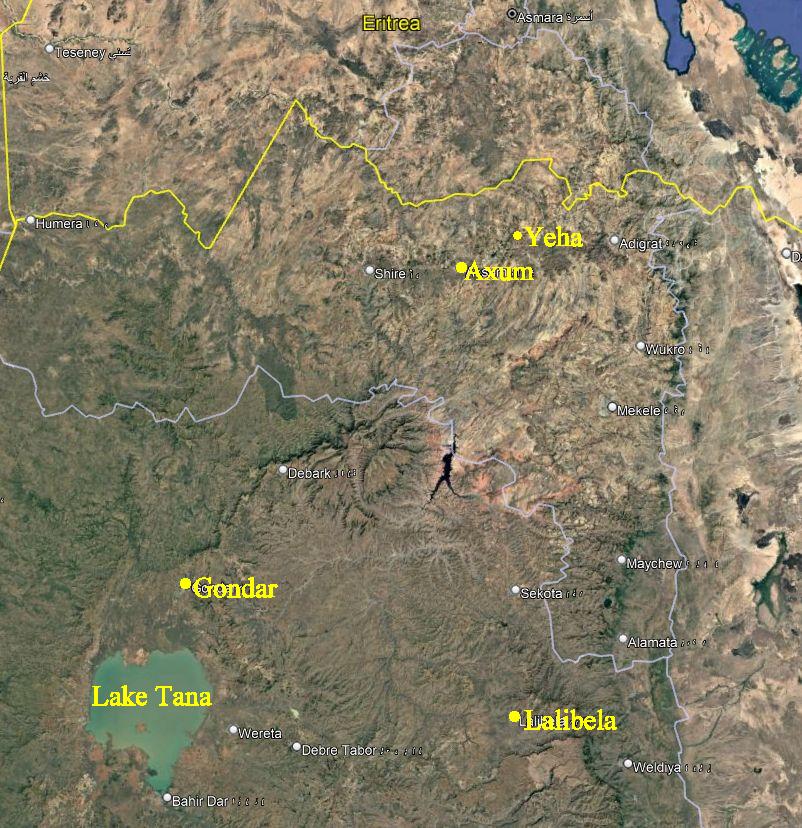
This is a Google Earth view of northern Ethiopia with four historical city locations marked. Only Yeha is known to exist in this Pre-Axum period.
This is a Google Earth view of northern Ethiopia with four historical city locations marked. Only Yeha is known to exist in this Pre-Axum period.
A people group called Di'amat (or D'mt) was known to be in the northern Ethiopia region from about the ninth to third century B.C. Little is known about this group because few inscriptions exist and little archaeological work has been done. One of its cities and temples still exist at Yeha.
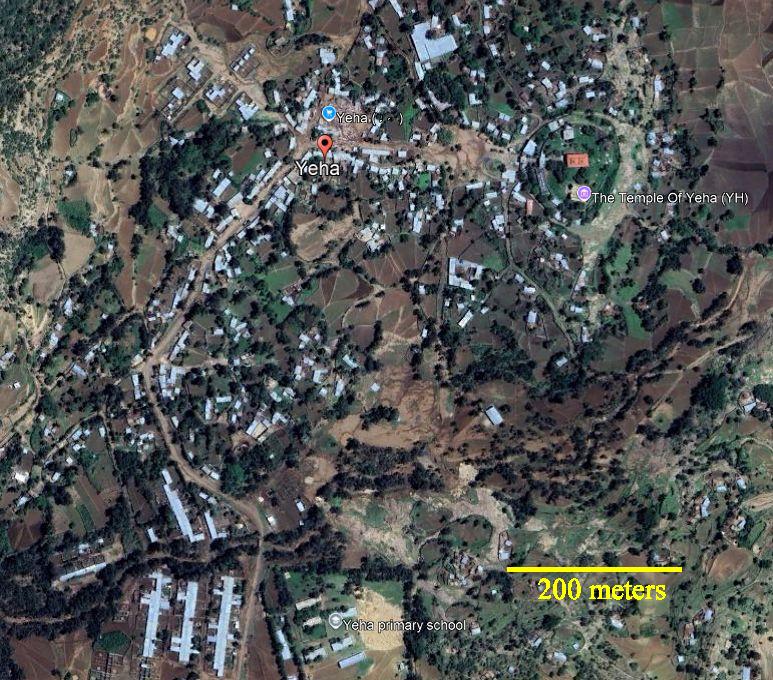
This is a Google Earth view of the village of Yeha. The ancient temple still exists in the upper right of this view.
Another group of this period and up to modern times is called Beta Israel, or House of Israel. There is historical documentation that this group is likely from the Tribe of Dan, of the Northern Kingdom of Israel. The documents indicate that they migrated to Ethiopia during the period of King Jeroboam II of Israel, a relatively prosperous period just before Assyria conquered the Northern Kingdom of Israel in 722 B.C. and exiled its important people into historical obscurity. Assyria imported other people groups into the Northern Kingdom area, and they became the Samaritans, as they are Biblically known at later times in history.
This people group in Ethiopia kept most but not all of the practices of the Israelites and Old Testament procedures. They suffered persecution from other people groups in Ethiopia and resettled to very high terrain where the rocky soil made agriculture difficult. In 1985 and 1991 the Israel government extracted most of this people group to Israel.
The Queen of Sheba visits King Solomon of Israel
The Bible records the visit of the Queen of Sheba with Solomon, King of Israel (970 - 921 B.C.), in the books 1 Kings 10:1-13 and 2 Chronicles 9:1-12. There was a major exchange of gifts and knowledge. Sheba is in southwestern Arabia (Yemen) and had economic and likely political exchanges across the Red Sea with what is now adjacent Eritrea and Ethiopia. This visit likely strengthened a trade route between Israel and the areas bordering the south end of the Red Sea. It happened after the building of the Temple in Jerusalem (967 - 960 B.C.), likely at a peak in Solomon's reign, but during his obvious decline in wisdom regarding women (1 Kings 11). This much of the story, being Biblical, can be regarded as truth.
However, an elaborate historical fiction version was written as "Kebra Nagast" (The Glory of the Kings) in the Ethiopian Ge'ez language in about 1314 to 1322 A.D., about 2250 years after that visit, with no documented trail of details in existence. It is noted that in 1270 A.D. the previous Zague Dynasty (based in Lalibela) was replaced by Yekuno Amlak who started the Solomonids Dynasty that lasted until 1974 when Emperor Haile Selassie was deposed. Yekuno Amlak claimed that he was a direct male descendant from Menelik I, the supposed son of Solomon and the Queen of Sheba. But he had no supported genealogy record spaning the two thousand years. The historical fiction was used to justify the 700 years of the new dynasty. However, the Biblical chapter of 1 Kings 11 shows the extreme promiscuity of Solomon, so the Queen of Sheba likely went home pregnant, leading to the birth of Menelik I.
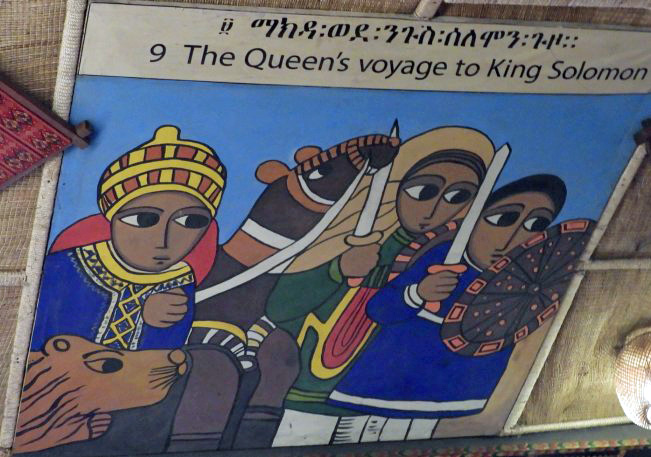 This is one of the series of restaurant ceiling panels that depict the visit between the Queen of Sheba and King Solomon. That restaurant in Addis Ababa had an interior name "Yod Abyssinia Ethiopian Cultural & Tourism Ambassador". Another panel said "They slept together." Other panels were out of range of our view. It is likely that at least one other panel proclaims the supposed birth of their son, Menelik I.
The Ark of the Covenant
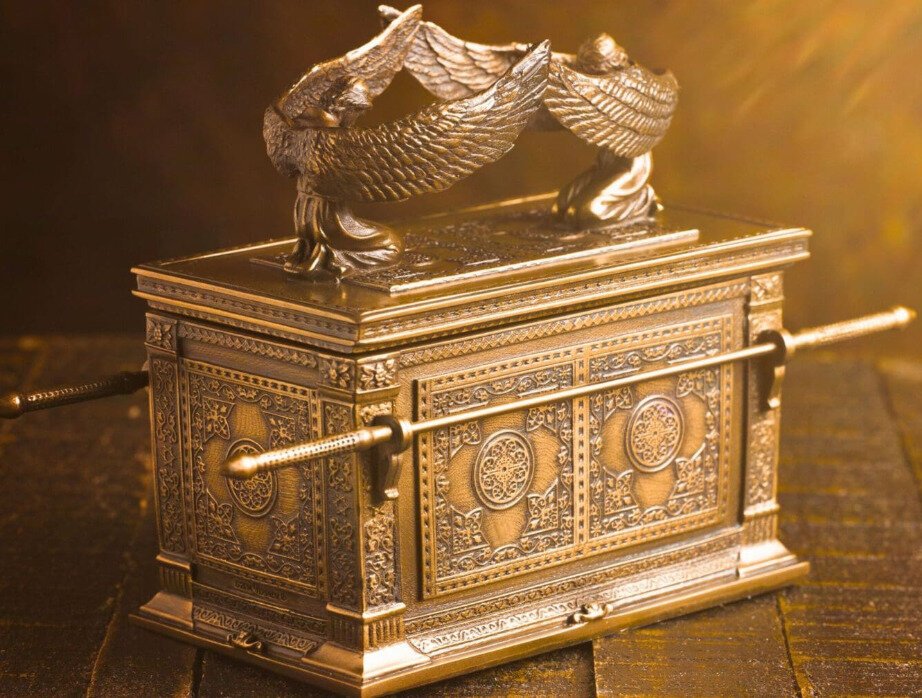
(Ark model, copied from image in aish.com)
The Ark of the Covenant is a big item in Ethiopian Orthodox culture. Major churches have their own replicas of it which are paraded on major holidays. Supposedly, the real Ark is kept hidden in a building in Axum, with a single priest as its caretaker. This Google Earth image shows its location.
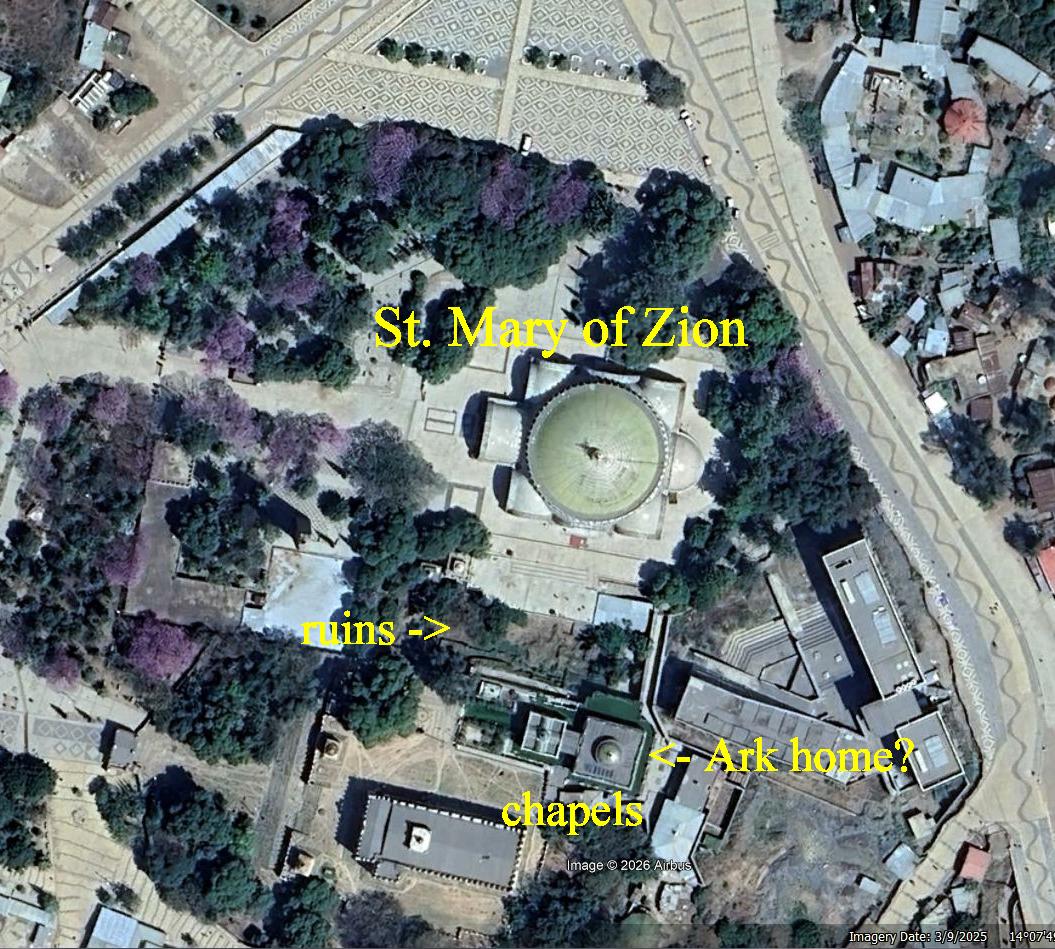
The present location is in the indicated chapel, with geographic coordinates N 14o 07' 46.92", E 38o 43' 10.78". Next are ruins of buildings that formerly housed the Ark.
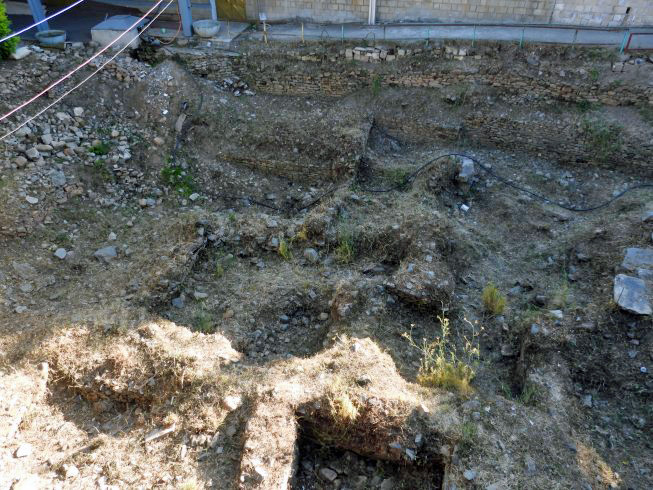
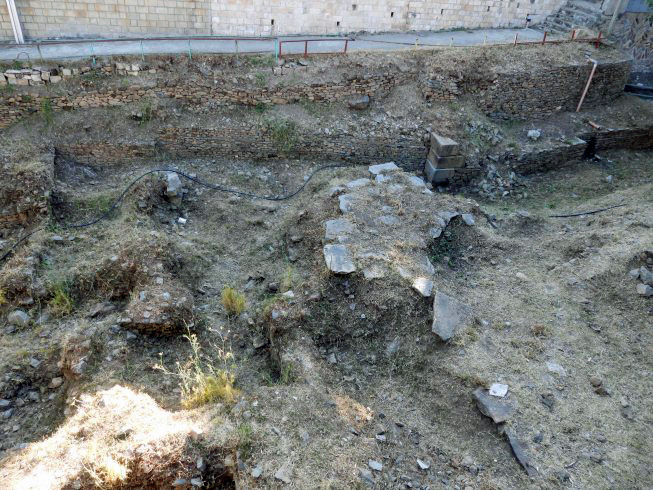
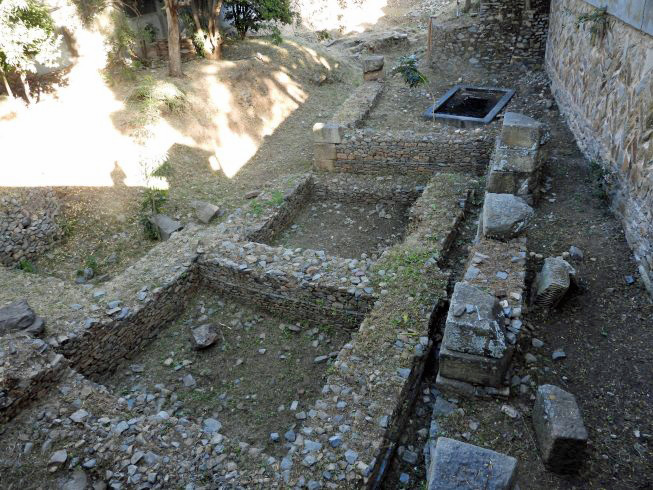
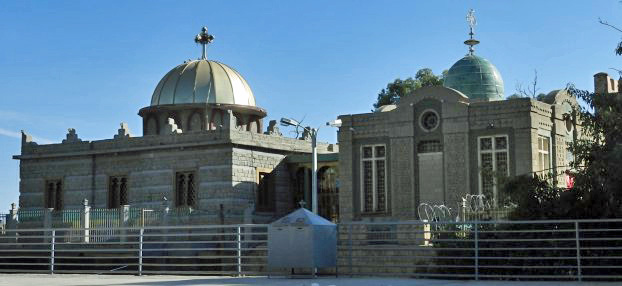 Of the subsequent buildings to house the Ark, the newer and larger one is on the left, as viewed from the north.
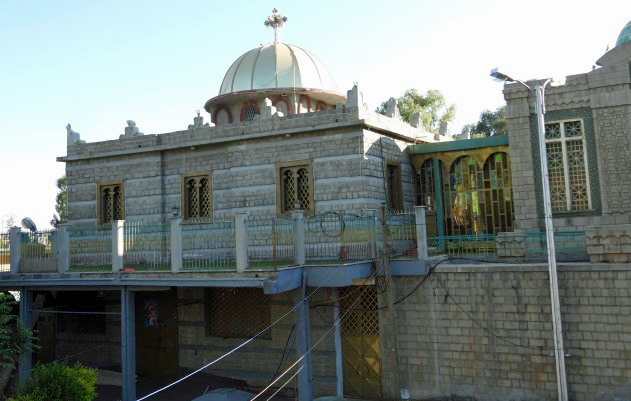 newer
newer
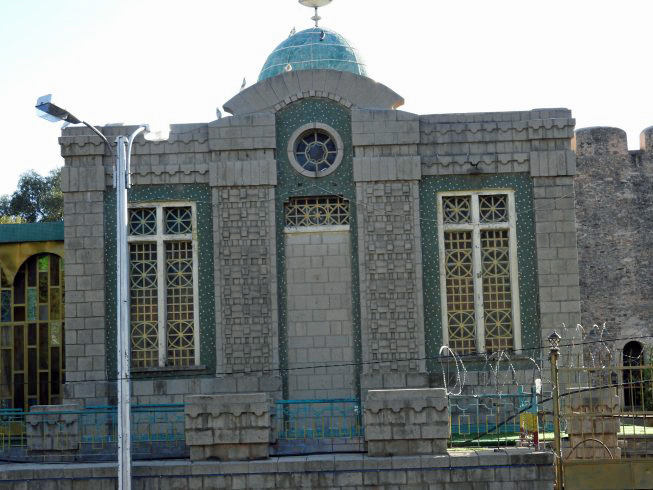 older
older
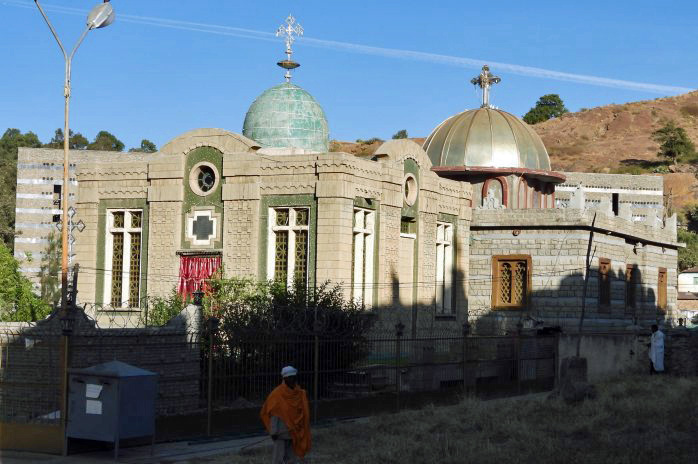
In this view from the southwest, the newer home for the Ark is on the right.
The only way to verify if the real Ark of the Covenant exists is to open it and see the stone tablets of the Commandments within it. However, the Bible lists some dangerous consequences for improper handling of the Ark.
The status of the Ark has been lost to history. The historical fiction account in Ethiopia, written in the Ge'ez language in "Kebra Nagast", indicates that Menelik I, son of the Queen of Sheba and King Solomon of Israel, went to Israel to see his father. Upon return his caretakers grabbed the Ark and brought it to Ethiopia where it has remained thereafter. For that to be true, Menelik I would be born a few years after the 960 B.C. completion of the Temple, and he would have traveled before the death of Solomon in 931 B.C. Menelik I would likely have been a young man then.
Foreign armies raided the Temple of gold things at times. The first and most major time was in 925 B.C. during the reign of Solomon’s foolish son, Rehoboam, when the Egyptian king Shishak took the Temple treasures, “everything”, and Palace gold shields (1 Kings 14:25-26). In 2 Chronicles 12:2-9, verse 9 says that the treasures of the house of the LORD and the treasures of the king's house were taken. That likely included the gold Ark of the Covenant in the Temple. Verse 3 says that the allies of Shishak included Ethiopians. Menelik I could have come with Shishak and obtained the Ark as his prize to take to Ethiopia in 925 B.C. rather than on any earlier visit to Jerusalem. (This scenario connects best with Biblical truths.)
Manasseh was very disrespectful of Temple items (2 Chronicles 33:1-9) and may have removed the Ark to storage. During Josiah’s reforms he commanded that the Ark be returned to the Temple (2 Chronicles 35:3) but there is no record that the Ark was actually found and moved. About the same time, Jeremiah writes (3:16) of a future reform in which the Ark will no longer be featured, remembered, or restored. Many Jews escaped to Egypt rather than be killed or exiled to Babylon (2 Kings 25:26), taking kidnaped Jeremiah with them (Jeremiah 43: 6-8). This was another opportunity for the removal of the Ark to Egypt and beyond, including south to Ethiopia, to avoid the capture of Egypt by Nebuchadnezzar in 567 B.C.).
In 587 B.C. the Temple was completely destroyed by the Babylonians and its valuable contents removed, with no mention of the survival of the Ark (2 Chronicles 36:18).
Though these speculations for the movement of the Ark of the Covenant to Ethiopia cannot be substantiated, there seem to be some justifications for the importance of the presence of the Ark in Axum even to modern times.
Navigate to other topics:
Home,
Rocks,
Pre-Axum,
Axum,
Lalibela,
Gondar,
crosses,
Palace Museum,
Cultural Dinner,
Hossana,
Synods,
dwellings,
transport,
Ethiopian Birds