
For 3 to 19 January 2026 I was on a Lutheran tour of Ethiopia offered by Master Builder Center (https://www.mbcnow.org/). Most of the team was involved with promoting the Parish Nursing program among Lutheran Synods in Ethiopia, providing care for mind, body, and spirit (https://www.lcms.org/how-we-serve/mercy/health-ministry/parish-nursing).
This report is more varied than most. So it is organized as a series of page links using simple HTML coding, with some entries as illustrated PDF documents, requiring the reader to use their own Return tool to get back into the series of links and/or this home page. At the bottom of HTML pages there will be a series of links to navigate forward or back or anywhere within this report.
I like to classify things by location and time, so when appropriate, there will be such illustrations to guide the reader. It is easy to construct a timeline for the Patriarchs whose stories are in the Biblical book of Genesis, starting from the Week of Creation, as in this diagram:
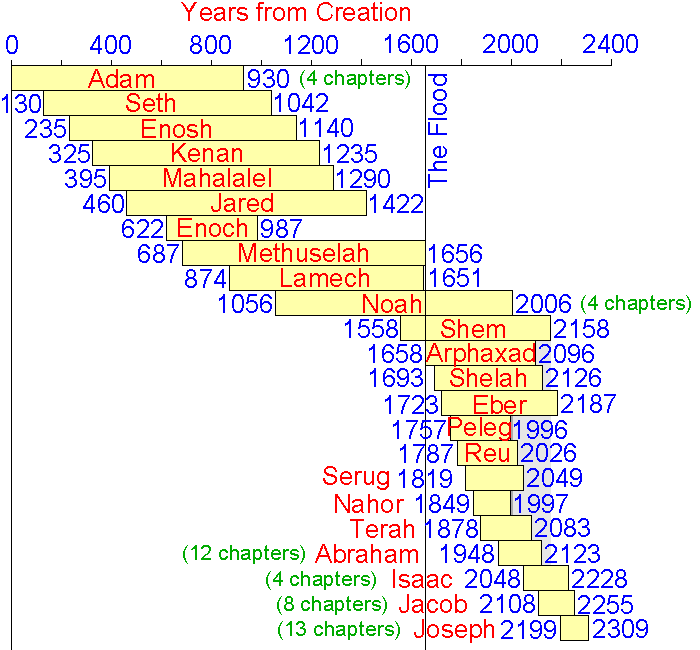
Birth and death years are indicated in blue for each person, named in red. It is obvious that the global Flood of Genesis 6 to 9 caused a change in lifespans. Less obvious is that two of the occupants of the Ark vessel lived long enough (somewhere) that they could have shared their stories face-to-face: Noah with Abraham, and Shem with Jacob, and passed on written records.
To convert "Years from Creation" to our calendar years system I used the comments in the Lutheran Study Bible (LSB) for the death years of Abraham and of Jacob. In both cases one should subtract 4114 years from the "Years from Creation" for events in the previous diagram, treating the negative numbers as B.C. years (and positive numbers as A.D. years). (That ignores the use of likely faulty Egyptian chronologies used in the LSB for earlier times.) That enables the creation of specific timelines like this one:
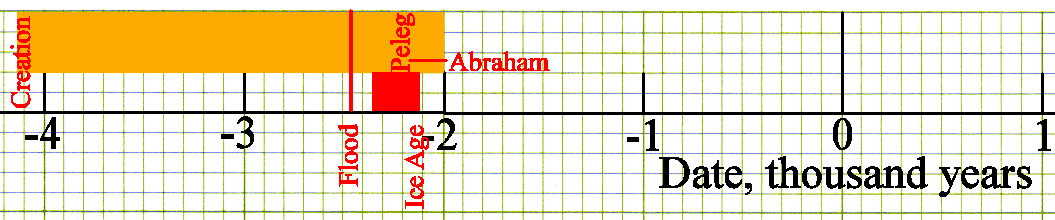
The orange bar illustrates the times of geologic interest for the world. Of major importance are Creation Week activity, the global Flood that resurfaced the entire world, and the Ice Age that developed within a few centuries after the Flood, was caused in part by the warm oceans and abundant volcanic activity, and lasted only many centuries, not millions of years.
The Bible mentions a division of the world at the time of Peleg. (His lifespan is in red rectangle.) Continental drift and separation was likely mostly confined to the Flood year and shortly thereafter. The Peleg division is more likely a dispersal of people groups caused by the abrupt multiplication of languages at Babel (Genesis 11). The lifespan of Abraham is indicated by the horizontal red line.
Rocks A summary of the geology of Ethiopia.
The Ice Age period caused the Sahara and Arabia areas to have rivers, lakes, and green vegetation, very unlike what is there today after significant climate changes took place. That likely helped the dispersal of the new people groups, with their distinct languages, around the world. In the Genesis 10 Table of Nations, verse 6 includes Cush (which is Ethiopia - Upper Nile region - the Blue Nile River starts in the large Lake Tana in northwestern Ethiopia) and Mizraim - which is Egypt in the Lower Nile region. Modern coins of Egypt have the Arabic script version of MISR for the name of Egypt. During this dispersion period, the family of Jacob moved to Egypt for a few centuries, then during the Exodus moved into the eventual area of Israel. It was not until about 1000 B.C. that Israel resembled a real nation in that region. Meanwhile Egypt and Ethiopia were also settled during the period indicated by the following Timeline.
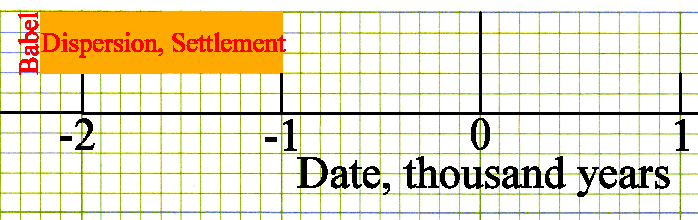
The next block of time (next following Timeline) has been very important for the culture of Ethiopia, so it will get a special link.
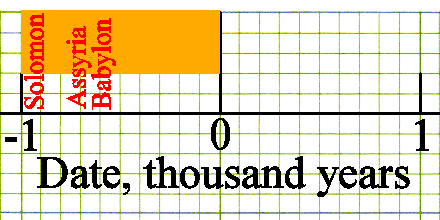
Pre-Axum A summary of important truths, legends and possibilities in the period before the Kingdom of Axum. That includes the Queen of Sheba visit to Solomon and Israel's Ark of the Covenant.
In the next Timeline period the nation of Axum in northern Ethiopia and Eritrea became as important as the civilizations of Rome, Greece, Persia, India, and China. It dominated the trade routes near the Red Sea until the spread of Islam cut off that commerce.
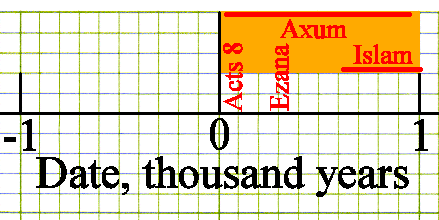
Axum A summary of the ancient history of Axum, with some photos of archaeological sites.
After the sacking of Axum in 940 A.D. the line of Axum kings came to an end. The region broke up into tribal units. Eventually the village of Roha became the home capital of the weak Zagwe Dynasty that lasted about 1137 to 1270. Lalibela had a pilgrimage to Jerusalem and later became king 1185 to 1225. When the Muslim capture of Jerusalem in 1187 cut off all future pilgrimages from Ethiopia, Lalibela started the construction of churches of carved stone as an alternate to Axum as a pilgrimage destination for Ethiopian Christians. Roha was renamed Lalibela in his honor, and that name remains to today, as well as pilgrimages.
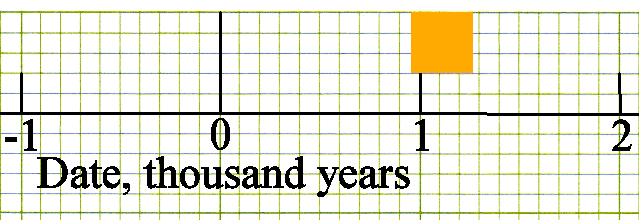
Lalibela Rock churches
The brief Zagwe Dynasty was deposed in 1270 and Yekuno Amlak started the Solomonids Dynasty which lasted until 1974. The capital kept moving until Fasiladas chose Gondar in 1632. The Solomonid kings claimed bloodline descent from Menelik I, the supposed son of the Queen of Sheba and King Solomon of Israel, though no genealogic support existed even for the Axum kings.
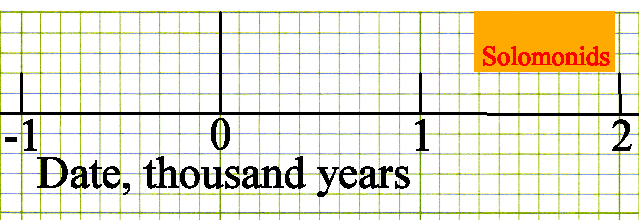
Gondar Solomonids
crosses Ethiopian crosses, individually crafted from bullet casings into symbols of peace and reconcilliation
Palace Museum end of Solomonid Dynasty
Cultural Dinner dinner, music, dances
Our main missions: Parish Nursing Training, Lutheran Synod visits
This Google Earth satellite image in central to southern Ethiopia is marked with places we visited. Diagonally through this image, particularly along the lakes of various colors, is the Rift Valley that divides Ethiopia.
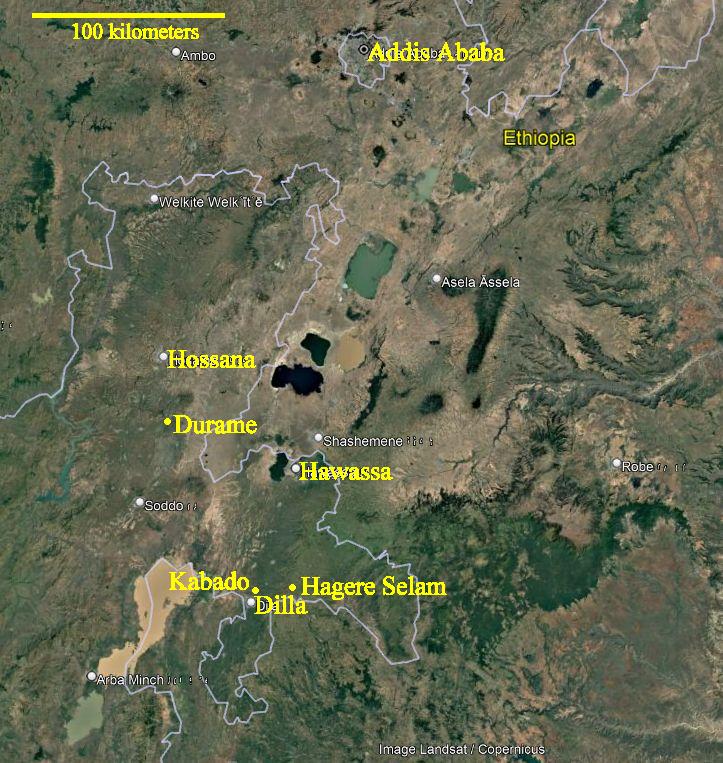
Hossana Training classes, church, prison, hospital visits
Synods Regional visits to Lutheran Synod headquarters
Extra topics
dwellings Rural home life
transport Rural transport
Ethiopian Birds (pdf file, use your own Return)
Navigate to other topics:
Home,
Rocks,
Pre-Axum,
Axum,
Lalibela,
Gondar,
crosses,
Palace Museum,
Cultural Dinner,
Hossana,
Synods,
dwellings,
transport,
Ethiopian Birds